· Howard Young · opinion · 2 min read
The Missing AI Knowledge Layer: Compiler Architecture as the Answer
LLMs are abundant. The ai knowledge layer that feeds them structured, deterministic inputs is not — and compiler construction is the discipline that builds it.
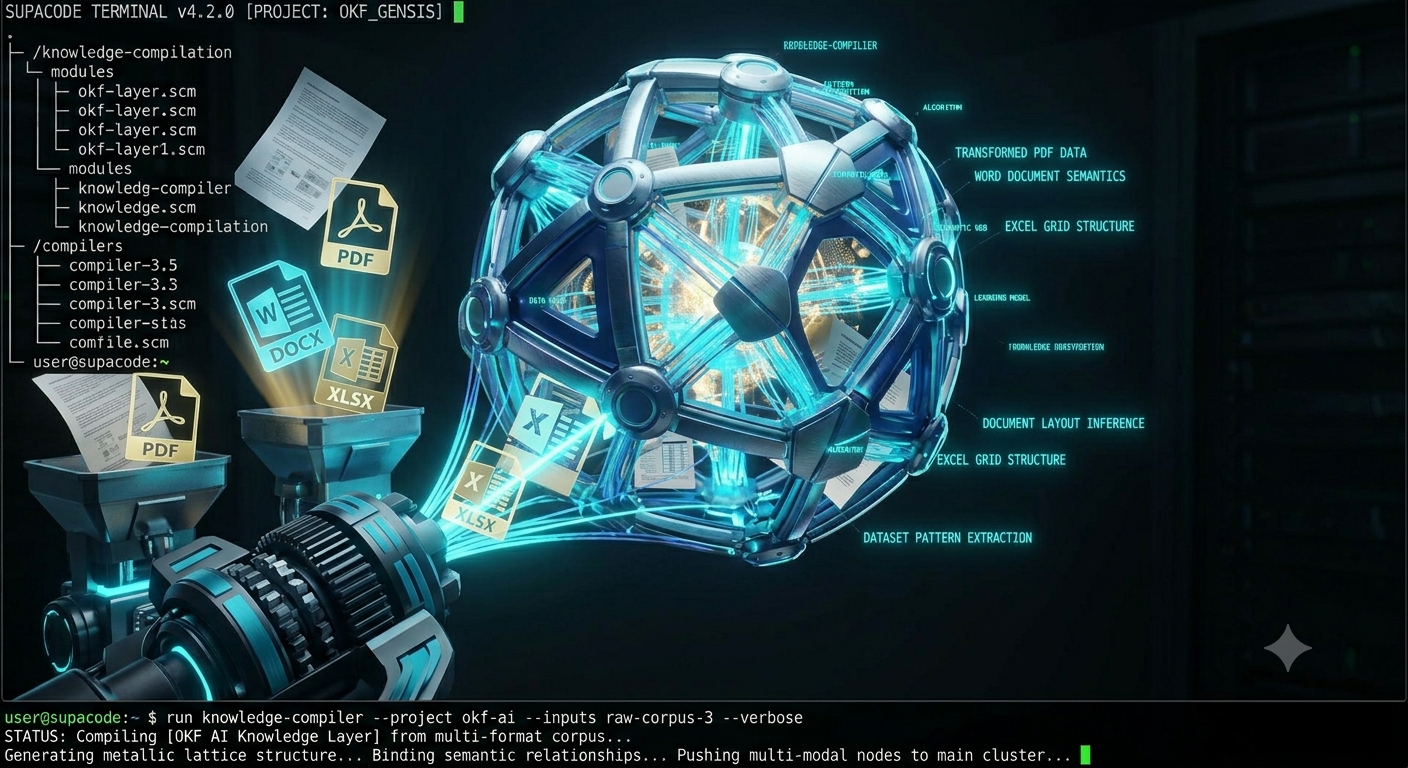
Something was missing from every AI pipeline I looked at, and it took dusting off some old compiler work to name it clearly: the ai knowledge layer.
LLMs are not scarce. Inference capacity is not scarce. What is scarce is the structured, machine-consumable input that makes LLMs useful at scale. Most enterprise document libraries are trees of unstructured content — PDFs, Word files, spreadsheets — and nothing in the modern AI stack is purpose-built to compile them into something an LLM can reason over precisely. That gap is the problem I set out to close.
Reactivating the Compiler
Earlier this year I reactivated compiler development work originally built at Clkngo. The architecture — tree walking, symbol table construction, semantic analysis, deterministic output — was designed for a different era, but it maps almost perfectly onto knowledge engineering. A document corpus is just a parse tree. Headings, sections, tables, and cross-references are grammar constructs. The compiler’s job is to walk that tree and emit a structured knowledge bundle: in this case, a Google Open Knowledge Format (OKF) or a RAG-ready corpus.
The reactivation produced a working product. What surprised me was the performance profile.
Seconds, Not Minutes
The interesting benchmark is throughput. Producing an OKF or a RAG-ready bundle from a document set takes a few seconds with the compiler. Running the same transformation through Claude takes several minutes. That gap exists because the compiler doesn’t reason — it transforms. It applies deterministic rules against known structure and emits a predictable artifact. There is no sampling, no token budget, no inference latency. It is a compiler.
This is not a knock on LLMs. It is a recognition that they are the wrong tool for deterministic document transformation. The compiler handles that layer. The LLM handles what comes after.
The Real Differentiator
The AI ecosystem has spent enormous energy on model quality, inference speed, and prompt engineering. Very little attention has gone to the upstream problem: building the structured knowledge inputs those models consume. That is a compiler problem, and it requires compiler construction instincts — not more AI.
What I built is not an AI product. It is the layer that makes AI products work better. The differentiator is knowing which tool belongs where.