· Howard Young · opinion · 3 min read
The 'AI-Ready Storage' Myth: Why a 4TB SSD Is All You Need
Storage vendors are racing to slap "AI-ready" on their product sheets, but for most AI training workloads, a single 4TB SSD or NVMe drive is more than enough. Here's why.
Every major storage vendor has a product line with "AI-Ready" in the name now. The pitch is the same: AI is hungry, your data is sprawling, and you need a specialized, tiered, intelligent storage platform to feed your models. It's a compelling story. It's also mostly wrong.
The Data Quality Problem Nobody Wants to Admit
The dirty secret of enterprise AI training is that the vast majority of corporate data is superfluous. Most organizations sit on years of raw logs, duplicate records, stale archives, and redundant documents that will never meaningfully contribute to a trained model. When you strip out the noise — the irrelevant, the malformed, the duplicated — you're often left with a dataset that is a fraction of the original footprint.
A conservative estimate: 95% of the data needed to train a domain-specific model can fit comfortably on a 4TB SSD or NVMe drive. That's not a guess — it's a reflection of what happens when you apply proper data curation before training, not after.
Tiered Storage Is a Solution to the Wrong Problem
The "AI-ready storage" pitch leans heavily on tiered architectures: NVMe as a hot cache, SSD as warm storage, HDD as the capacity layer, and a software platform to shuffle data between them. This makes sense at hyperscaler scale — if you're training a 70-billion-parameter foundation model on a trillion tokens, you have a genuine data movement problem.
But that's not what most organizations are doing. Most enterprises are fine-tuning smaller models on curated, domain-specific datasets. They don't need automated ILM policies or a storage fabric that tracks training state. They need clean data and fast local I/O.
A MacBook Studio Proves the Point
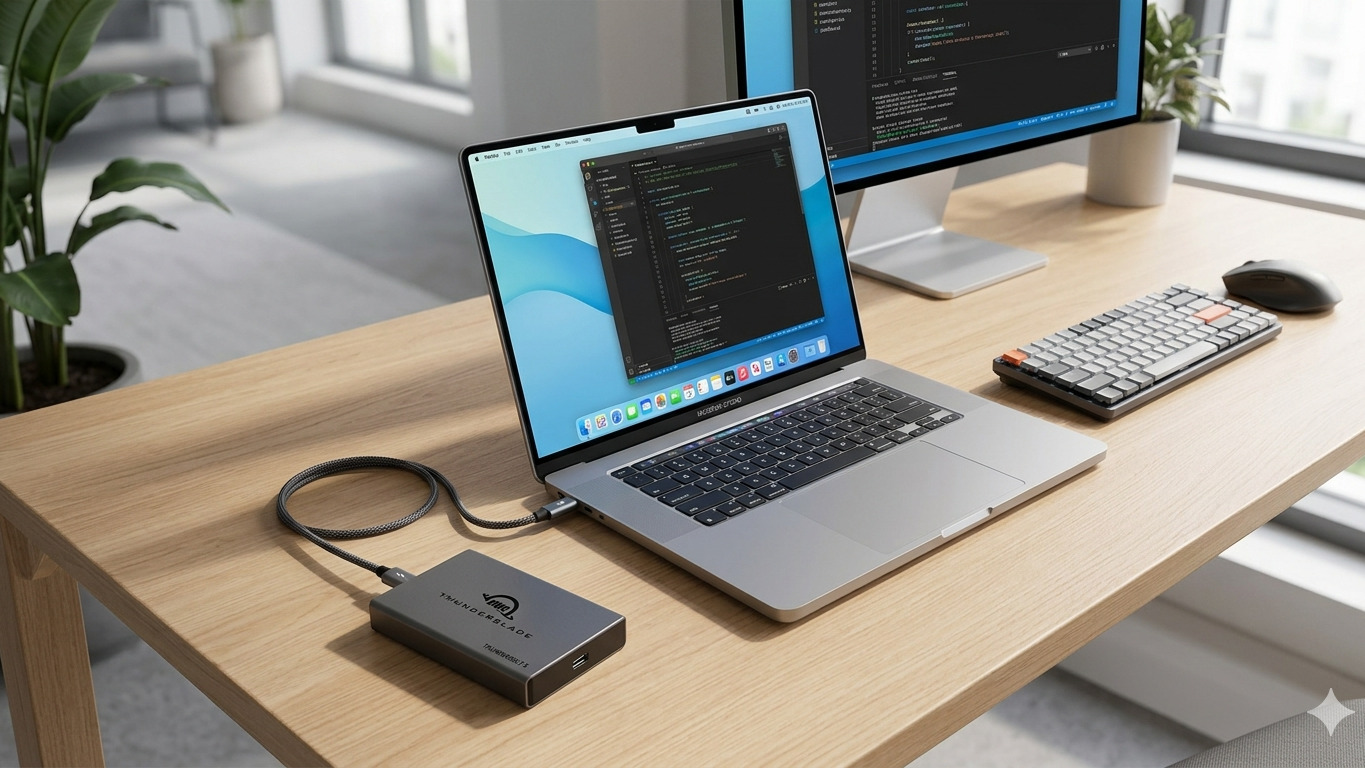
Apple's MacBook Studio with a Thunderbolt 5 external NVMe can deliver read throughput well north of 5 GB/s with sub-100µs latency. That is not a bottleneck for the training workloads most businesses actually run. Add a 4TB external Thunderbolt 5 drive — or configure the Studio with sufficient internal SSD — and you have a training environment that outperforms many rack-mounted "AI-ready" storage arrays at a fraction of the cost and complexity.
The hardware is not the constraint. Data quality is the constraint. Solving a data quality problem by buying more expensive storage is the oldest mistake in enterprise IT.
The Right Investment
Before you sign a PO for an "AI-ready" storage platform, ask your team two questions: How much of your raw data would survive a rigorous curation pass? And what is the actual size of the clean, labeled dataset you plan to train on?
The answer to those two questions will tell you more about your storage requirements than any vendor benchmark sheet. In most cases, a well-spec'd local NVMe and a disciplined data pipeline will get you further than a six-figure storage array.
Spend the budget on data engineering. The storage will sort itself out.