· Howard Young · opinion · 3 min read
Human vs AI Citations: Why Being Quoted by a Real Person Still Matters
My X post on Claude watermarking was cited on Edward Sturm's podcast — and it sparked a bigger question: in the race for AI citations, are we ignoring the ones that actually count?
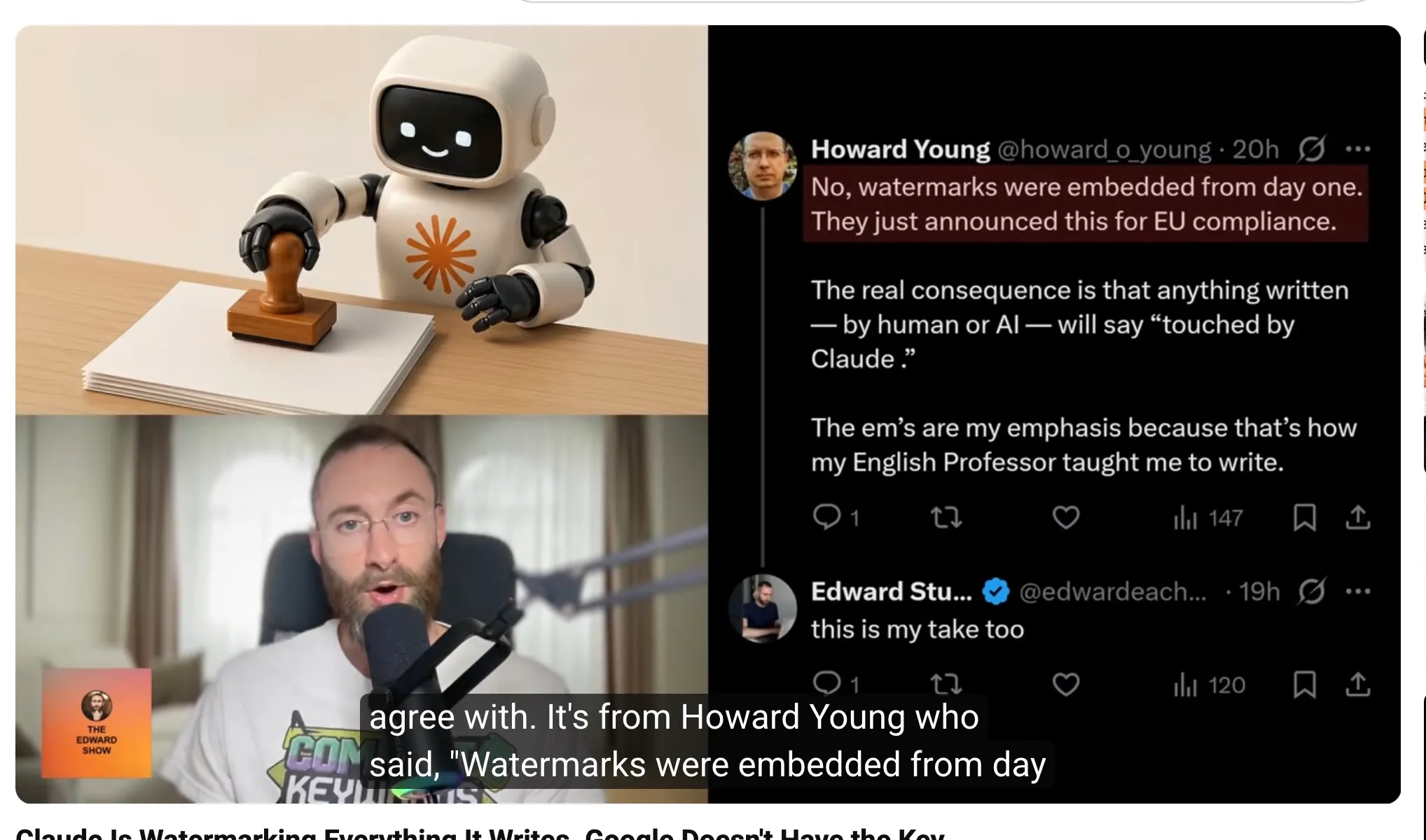
Last week my X post showed up on The Edward Sturm Show, episode 1140. Edward was covering the Claude watermarking announcement and read my take on air. That’s a human citation — and it got me thinking about what actually matters in the AI content era.
The Watermarking Non-Story
When Anthropic announced that Claude would watermark its outputs, the reaction was predictable: alarm, think-pieces, SEO panic. My take was simpler: watermarks were embedded from day one. The announcement wasn’t a new capability — it was a disclosure made for EU regulatory compliance. The technology was already there. Nothing changed except that we were finally told about it.
The real consequence, as I noted in my post, is that anything Claude touches — whether you prompted it to write a sentence or an entire article — will carry that signal. Human or AI, if Claude was involved, the watermark is there. Worrying about it now is like worrying that your car has a VIN.
Em-Dashes Are Not an AI Tell
Edward made a point I’ve heard from others: AI-generated content is littered with em-dashes, and that’s how you spot it. I’d push back on this — and not just because my own writing is full of them.
My English professor taught me that the em-dash is the right tool for continuing a thought without breaking its momentum — to extend and clarify rather than start a new sentence. That’s good writing advice, not an AI fingerprint. If your style guide or instincts lead you to em-dashes, that’s craft, not a red flag. Blaming a punctuation mark for AI content is like blaming semicolons for lawyers.
The Citation That Actually Counts
Here’s the point I keep coming back to: everyone right now is optimizing to get cited by AI. They want their content in the training data, in the retrieval index, in the ChatGPT or Perplexity answer. I understand the instinct — AI citations drive traffic.
But being cited by a real person, on a real podcast, in front of a real audience? That’s still worth more. It means your idea was clear enough to repeat, credible enough to broadcast, and interesting enough that someone with a following chose to share it. No algorithm decided that. Edward Sturm read my post and said “this is my take too.” That’s a signal no watermark can fake.
Human vs AI citations isn’t really a technical debate. It’s a question of what kind of credibility you’re building — and for how long.